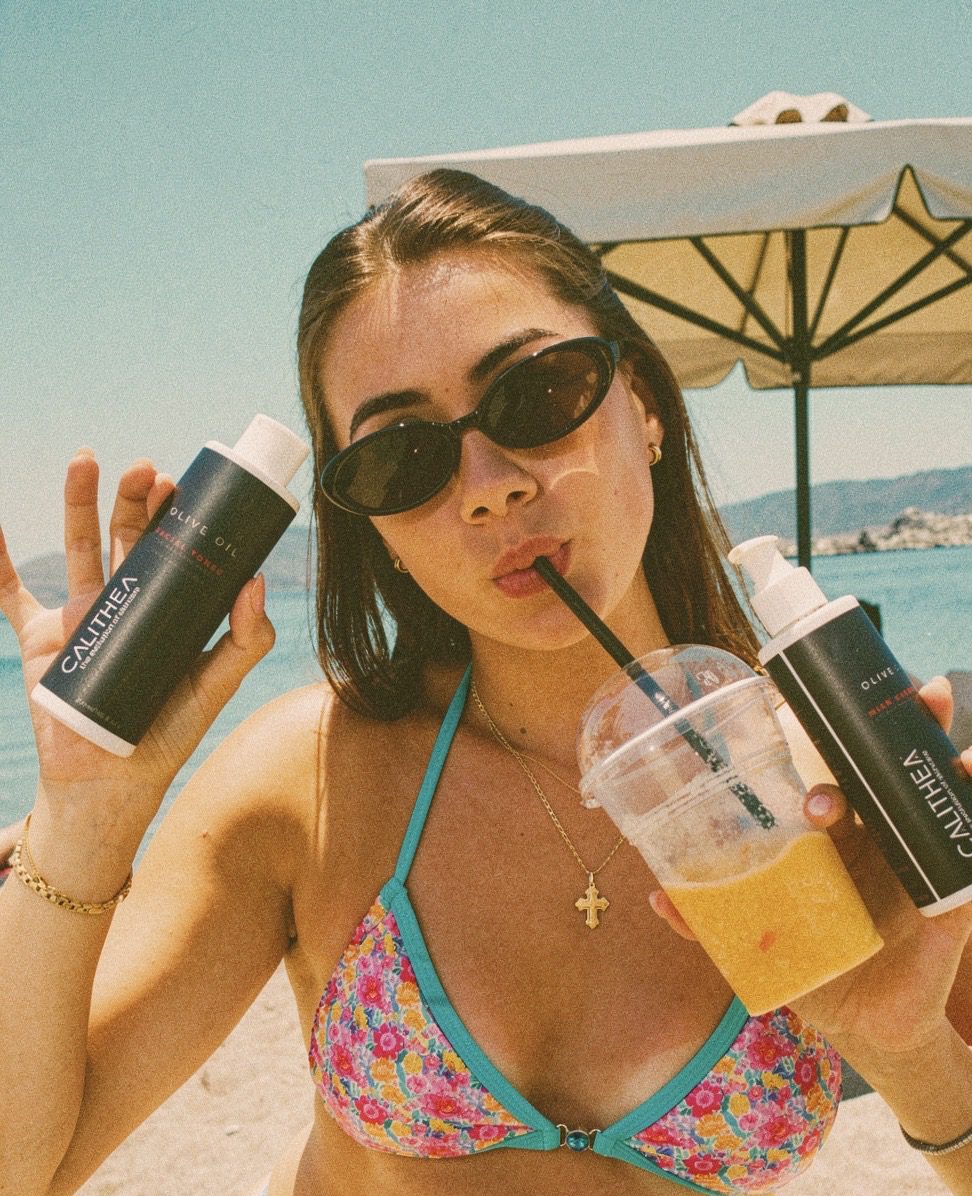
Understanding your skin barrier can change the way you approach skincare. Discover what it does, why hydration and moisturization work together, and how modern skincare technology meets the traditions of Greek beauty.
Have you ever felt like you’re constantly applying moisturizer, yet your skin still feels dry, tight, inflamed, disrupted, or uncomfortable? Or wondered why adding more products to your skincare routine doesn’t always give you the results you’re looking for?
The answer may begin with understanding your skin barrier.
As the co-founder of Calithea Skincare, I’ve spent years learning about skincare ingredients, formulations, and the traditions that inspired our brand. But I wanted to understand the skin itself on an even deeper level, which is one of the reasons I decided to return to school to study esthetics.
One of the most fascinating topics I’ve been learning about is the skin barrier. Once you understand how it works, so many aspects of skincare begin to make more sense.
Let’s break down what your skin barrier does, why hydration and moisturization are not the same thing, and how Calithea’s Olive Oil Liquid Crystal System was designed to support healthy-looking skin.
What Is the Skin Barrier?
Think of your skin barrier as your body’s first line of defense.
Your skin does much more than affect your appearance. It helps protect your body from external irritants, environmental stressors, and excessive moisture loss.
One of the easiest ways to understand the skin barrier is through the brick-and-mortar analogy.
Imagine a brick wall:
- The bricks: Your skin cells.
- The mortar: The lipids, or natural fats, that help hold everything together.
When the bricks and mortar work together properly, the wall remains strong and intact. Your skin barrier works in a similar way.
When this structure is functioning well, your skin tends to feel more comfortable and hydrated. When the barrier becomes disrupted, you may notice signs such as dryness, tightness, flaking, redness, or increased sensitivity.
This is why supporting your skin barrier is such an important part of a thoughtful skincare routine.
What Is TEWL? Understanding Moisture Loss
Another term you’ll often hear when learning about skin health is TEWL, which stands for transepidermal water loss.
In simple terms, TEWL refers to the movement of water through the skin and its evaporation from the skin’s surface.
Here’s an easy way to picture it.
Imagine filling a bucket with water, but the bucket has tiny holes in it. You can continue pouring water into the bucket, but some of that water will keep escaping.
Your skin can experience something similar. When its barrier is compromised, water can escape more easily.
This is why skincare isn’t always just about adding more hydration. It’s also about helping your skin retain the moisture it needs.
The goal is not only to hydrate your skin, but also to support the barrier that helps keep that hydration in.
Hydration vs. Moisturization: What’s the Difference?
Hydration and moisturization are two terms that are often used interchangeably, but they serve different purposes in skincare.
Understanding the difference can help you make more informed decisions about the products you use.
Hydration: Adding Water to the Picture
Hydrating ingredients help attract and hold water in the skin.
Some familiar examples include:
- Hyaluronic acid: Helps attract and retain water.
- Glycerin: A humectant that draws water into the outer layers of the skin.
- Aloe vera: An ingredient commonly used in hydrating skincare formulations.
I like to think of hydration as filling a cup with water. You’re giving your skin access to the water it needs to feel hydrated.
But what happens if that water doesn’t stay where you want it?
That’s where moisturization comes in.
Moisturization: Helping Keep Hydration In
Moisturizing ingredients help soften the skin, support its protective barrier, and reduce moisture loss.
Examples include:
- Shea butter: Helps soften the skin and reduce moisture loss.
- Squalane: An emollient that helps soften and smooth the skin.
- Plant oils: Can help condition the skin and support moisture retention.
Think of moisturization as putting a lid on your cup. Hydration helps fill it, while moisturization helps keep it full to prevent evaporation (TEWL).
Of course, ingredients can have overlapping functions, and how they perform depends on the overall formulation.
The important takeaway? Hydration and moisturization work together. A well-rounded skincare routine considers both rather than focusing on just one.
Why Your Skin Barrier Should Be Part of Your Skincare Routine
With so many skincare products and trending ingredients available, it’s easy to feel like you need to keep adding more to your routine.
But more products don’t necessarily mean better skin.
Sometimes, the most helpful place to start is by understanding what your skin needs and building a routine around those needs.
A thoughtful routine can focus on four essentials:
1. Cleansing
Remove everyday buildup, excess oil, and impurities with a cleanser suited to your skin. Cleansing should leave your skin feeling comfortable rather than unnecessarily stripped or tight.
2. Hydration
Incorporate ingredients that help attract and hold water in the skin.
Use products that help soften the skin and reduce moisture loss.
4. Barrier support
Choose skincare formulated to support the skin’s natural protective function, particularly if dryness or discomfort is a concern.
Your skin’s needs will vary depending on your skin type, environment, and other factors. The goal isn’t to follow the most complicated routine. It’s to understand the purpose behind each step.
The Science Behind Calithea’s Olive Oil Liquid Crystal System
Understanding the skin barrier made me even more interested in the technology behind Calithea’s formulations.
At Calithea, we believe skincare can bring together time-honored ingredients and modern formulation science. That’s why our products are built around an Olive Oil Liquid Crystal System made with EVOO
Olive oil has been used throughout Greece for generations as part of traditional skin and body care. It’s an ingredient deeply connected to the heritage that inspired Calithea.
But what makes our approach particularly interesting is how we pair this traditional ingredient with liquid crystal technology.
What Is a Liquid Crystal System?
Traditional creams generally combine oil and water using an emulsifying system. Liquid crystal technology takes a different approach to how ingredients are organized within a formulation.
Liquid crystals can form highly organized layered structures that resemble aspects of the lipid organization found naturally in the skin.
This is an example of biomimetic technology.
The word bio relates to life, while mimetic means to imitate or mimic. In skincare, biomimetic approaches draw inspiration from the way biological structures naturally work.
In simple terms, Calithea’s Olive Oil Liquid Crystal System was designed to work in harmony with the skin’s natural structure.
So, what does that mean for your skincare routine?
1. Supporting the Skin Barrier
Remember the brick-and-mortar analogy?
The skin’s lipids help hold its protective structure together. Calithea’s liquid crystal technology is designed to support barrier integrity by using an organized structure inspired by the skin’s own lipid organization.
The goal is to help support the skin’s natural protective function and moisture retention.
2. Helping Skin Retain Moisture
Let’s return to our bucket analogy.
When water escapes too easily, adding hydration alone may not address the whole picture. Supporting the skin barrier is another important part of maintaining comfortable, hydrated skin.
By helping support barrier integrity, Calithea’s Olive Oil Liquid Crystal System is designed to promote moisture retention and sustained hydration.
This is why we believe barrier support and hydration belong in the same conversation.
3. Helping Deliver Beneficial Ingredients
Liquid crystal systems can also serve as carrier systems for ingredients within a skincare formulation.
Because these structures are organized in a way that resembles aspects of the skin’s lipid structure, they can help facilitate the delivery of beneficial ingredients into the upper layers of the skin.
For Calithea, this is an exciting way to pair plant-based ingredients with modern formulation technology.
The performance of an ingredient delivery system depends on the complete formulation, so the technology should be understood as part of the overall product rather than a guarantee of a particular result.
4. Supporting Skin Against Everyday Environmental Stressors
Our skin encounters environmental stressors every day, including dry air, changing weather, and pollution.
The skin barrier plays an important role in protecting against external influences and limiting moisture loss.
Supporting the skin barrier helps maintain its protective function, which is one reason barrier-conscious skincare is worth considering throughout the year.
5. Promoting Lasting Hydration and Healthy-Looking Radiance
When skin is adequately hydrated, it often looks smoother and feels softer and more comfortable.
Calithea’s Olive Oil Liquid Crystal System was designed to support the skin barrier and help maintain hydration over time.
Rather than thinking of radiance as something that comes only from a particular product or trendy ingredient, we believe it is worth starting with the fundamentals: cleansing, hydration, moisturization, and supporting the skin’s natural protective function.
Healthy-looking skin begins with understanding what helps it function at its best.
Why Olive Oil? Where Greek Tradition Meets Modern Skincare
At Calithea, olive oil represents more than an ingredient. It connects our formulations to the Greek skincare traditions that helped inspire our brand.
Growing up with the influence of my grandmother and her Greek heritage taught me to appreciate simplicity and the ingredients that nature provides.
Olive oil has been part of Greek life for centuries, including traditional approaches to skin and body care. We wanted to honor that history while exploring how modern skincare science could build upon it.
By combining organic Cretan olive oil with liquid crystal technology, Calithea brings together two things we value deeply: tradition and innovation.
Our philosophy has always been that skincare doesn’t need to be unnecessarily complicated. We want to help people understand the ingredients in their products, why those ingredients are used, and how thoughtful formulations can fit into their routines.
For us, the Olive Oil Liquid Crystal System represents that philosophy in action.
The Takeaway: Healthy Skin Isn’t Always About Doing More
One of the biggest things I’ve learned through studying esthetics is that understanding the skin can change the way you approach skincare.
You don’t necessarily need another trending product or a longer routine. Sometimes, it’s about going back to the basics and understanding what your skin needs.
Remember these four takeaways:
- Your skin barrier matters. It helps protect your skin and limit excessive moisture loss.
- Hydration and moisturization are different. Hydration helps attract and hold water, while moisturizing ingredients help soften skin and support moisture retention.
- Barrier support and hydration work together. Supporting the skin’s protective function is an important part of maintaining comfortable, healthy-looking skin.
- Formulation matters. The way ingredients are combined and organized can be just as important as the ingredients themselves.
At Calithea, our Olive Oil Liquid Crystal System was developed to bring these principles together, helping support barrier integrity, moisture retention, and hydrated, healthy-looking skin.
It’s one of the ways we combine the Greek traditions that inspired our brand with a deeper understanding of modern skincare formulation.
Because sometimes, the first step toward better skincare isn’t doing more. It’s understanding your skin a little better.
Discover the Calithea Skincare collection and explore our approach to skincare inspired by Greek tradition and modern formulation science.
With love,
Elena Kazas
Co-Founder, Calithea Skincare
P.S. you can watch my Amazon Live explaining all of this here: Skin Barrier 101 with an Esthetician Student Calithea Skin